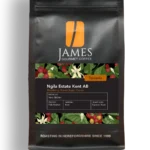
I am a big Vera fan! Vera is a quietly assured, lovely human being. During Covid, I discovered her coffee and, alongside other Tanzanian producers of the Ngorongoro Crater, some of whom were pushing the envelope of unusual processing and moisture content. Ngila Estate was this coffee that (to me) sang a song of terroir. No gimmicks, just great levels of softness, sweetness and fruit.
You have to love what great Tanzanian coffee does in the cup. Unlike other East African coffees, it is a softer and gentler way to start the day. Lower acidity and a more genteel cup.
This is the “base” coffee. We have our biggest range ever from Vera this year and some absolute gems.
Owner: Vera Stucker
Farm: Ngila Estate.
Area: Arusha Northern Tanzania
Process: Fully washed (and shade-grown)
Varietal: Kent, screen AB
Altitude: 1560-1640 Meters above sea level
Roast: Espresso Roast. Not quite as developed as Simply Brazil or Formula 6, but not far behind.
The Ngila Estate is based on the slopes of the Ngorongoro Crater, and they have been growing coffee for over 100 years. There is a set aside of 80 hectares of preserved rainforest that reaches 1800 meters above sea level. Ngila is certified by the Rainforest Alliance and uses natural insecticides, like Neem extract, and mineral fertilisers.
Ngila determines the trees that they are going to pick using a Brix meter; picking is selective, and sorting is very intensive. Many of the workforce at Ngila are migrants. For some, it is a break from stone crushing, which is another local manual labour.
Tanzania has a growing population of over 60 million people. The population has grown by a million a year for the last 50 years. Yes, that is a population growth of 5-fold in 50 years.
This was an easy coffee to set up. Tasty shots flowed from the mid-20 seconds range…
Shot recipe, 7 days from roast: 17-17.5g of coffee into 35g of espresso, 24 seconds and beyond.
9oz Milk-based drink, this is a rich mixture of malt, soft Autumnal fruit and cocoa. The fruit is relatively shy here.
5-6oz Fruity background, malt and cocoa.
Espresso recipe: 16-17g of coffee into 45+g of espresso, extracted in 25-30 secs ish around 94C as a rough guide. Always taste it as you are dialling in, you might find something new that you like at either end of the time spectrum.
For me, the espresso has a light body, sweet soft acidity (think blackberry) and a linger of brown sugar, cocoa. From this unassuming milk drink comes a juicy, complex and delicious espresso. Arguably, we could start again and increase our base brew to 19g of coffee for milk drinks; however, I feel this is unfair to suggest, and for similar reasons that we don’t just roast it darker.