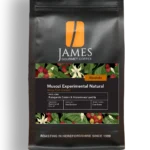
Here is a new coffee process that, from here on, will be referred to as an experimental Natural. It was going to be called an F1; however, this means other things in the world of coffee and horticulture.
Here is the first season of a new process that has been produced by Rwamatamu. Gaston observed how alternative processes had won the best coffees in Rwanda, and this is his interpretation. Let’s face it, we rarely do anything truly original individually or as a species. Cough, cough, Google.
This process is a cross between a natural and an anaerobic process, where the cherries are piled in a triangular mound on the drying beds and covered. This creates some of the advantages of a natural, but deeper, wilder red fruity characteristics.
I love the fact that if you trawl the internet looking for almost anything Rwanda and coffee related, Rwamatamu pops up. It’s a great thing that so many coffee roasters are part of this story. Historically, Rwanda has been a big part of our year, and we buy a lot relatively speaking.
If you would like to know a little more about the very basics of Rwandan Coffee, I wrote a brief outline on our blog. There are some great links to the UN (who have a great educational website) and the NAEB. It was interesting for me anyway!
Processing: Coffee Washing Station: Mbare
Washing Station: Mbare, Western Province, Rwanda, near the Kiyube District
Owners: Rutaganda Gaston and Mukantwaza Laetitia
Lot Name: “Musozi” (Translates into Old man or Gaffer; family joke for Gaston).
Growing Region: Nyamasheke (this is where the original Rwamatamu washing station was based)
Varietal: Red Bourbon
Process: Currently, this process is called an “F1”. I have issue with this due to the connotations with agriculture and horticulture already in existence.
We are going with the label of “Experimental”. This process is where ripe cherries, with their pulp still on, are put in a mound, which is then covered. The effect is a cross between a natural and an anaerobic process. You have the advantages of a natural, with (arguably a greater depth of flavour) and much less work. Anoxic/ anaerobic coffees are very manual-intensive and open to risk. The flavour is unlike a full-on anaerobic and infinitely more subtle.
This journey was made possible by our friends at Omwani.
Rwamatamu Coffee Company is the name of a Rwandan family coffee business that was set up in 2015.
The business was set up to employ and empower people in the local area, which Gaston, Laetitia, Marie Bernice and Pappie are all part of.
Today, Dad and Mum (Gaston and Laetitia) work alongside their son, Pappie, with Marie living in the U.S. There is so much mutual
respect between the whole team, at Mbare (CWS), for these lovely human beings and their open-hearted mission.
This family is driven to provide opportunities for young people to work and grow in Rwanda.
For a little background on Rwandan Coffee, Try here
In a cupping Bowl:
Aromatics: Ripe and Deep, Boozy brown Sugars,
Body: Medium+
Acidity: Soft, subtle, ripe, boozy.
On opening, if you have rested this coffee for a few weeks, you would be forgiven for asking, “What is this?” because it is not quite like anything else! My first taste is very different from the aromatics. Is this chocolatey? Savoury? Two degrees later, a soft acidity emerges with a little boozy edge to it. Although this is a light roast, it has a superb depth of flavour. Lychee-blueberry, cooling to raspberry.
This is a boozy fruit cocktail, and we just love it!
Espresso:
If you can increase your brew temperature to 95 °C, this is a good start. It is not the end of the world (!), as the type of espresso machine can make a big difference to what you experience. Dosing at 18g made this an even better experience, for the body and soluble.
18g-34-36g of liquid for milk-based drinks.
Slightly longer extractions are good with a lighter roast like this, so aim for 27-32 seconds for milk-based drinks and 30-35 seconds for espresso.
9oz Milk-based drinks: Strawberry, Chocolate milkshake
6oz Milk-based drinks: Chocolate and boozy
18g of coffee into 45-50g of espresso.
Espresso: You get the benefit of the sweet, soft acidity that carries through here.