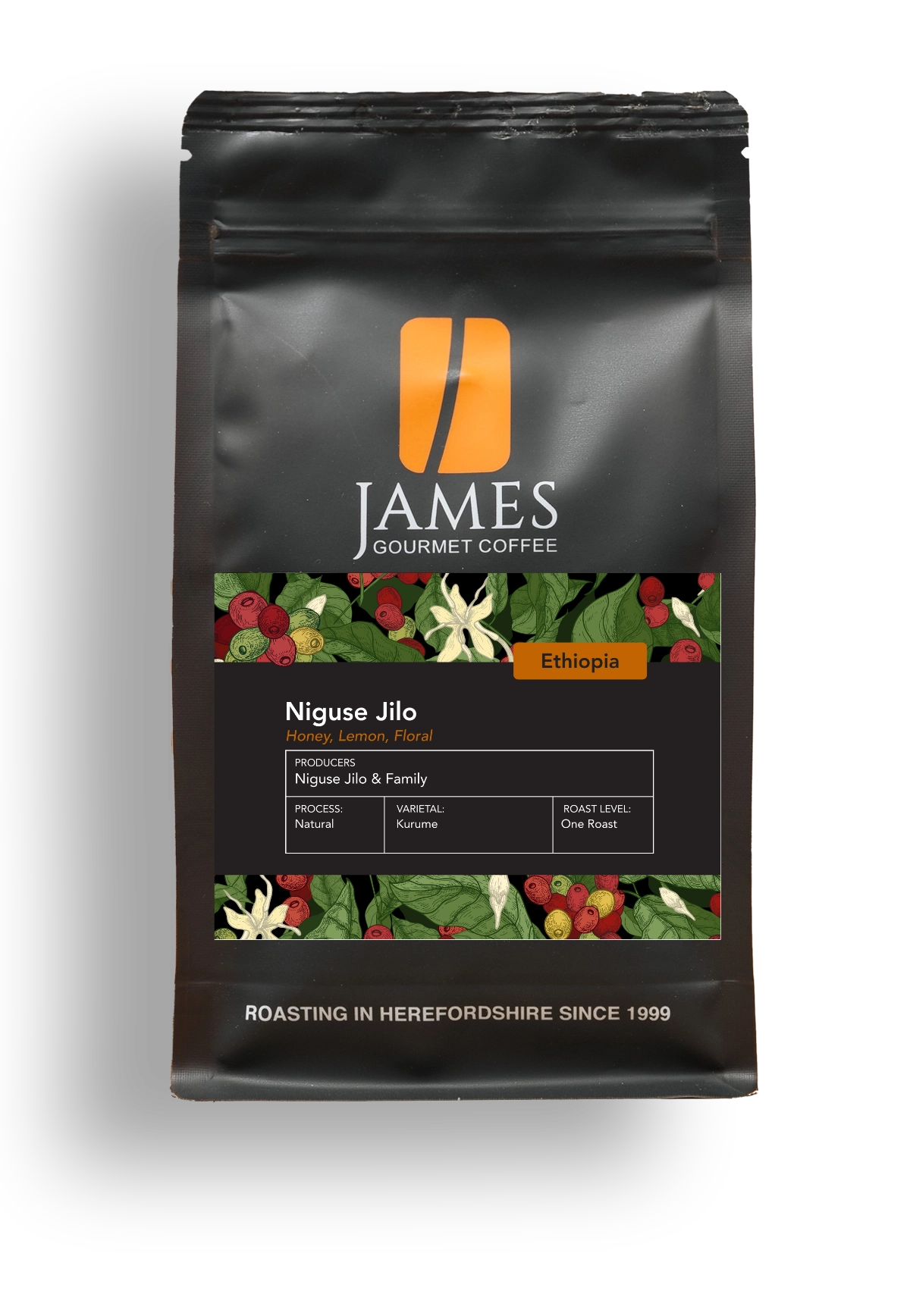
Ethiopian Niguse Jilo One Roast
Here is the first of our Ethiopian smallholder farmers that we are bringing to you this season. Niguse made #36 in the Ethiopian Cup of Excellence in 2024, which is epic. Being recognised in this way is fantastic for producers and can be positively life-changing.
We have tried to buy as much coffee as we can this way, to make an impact, rather than just having these as trophy coffees. (Don’t get me started).
Working in coffee is a privilege, and when we get access to coffees like these, this is not a job; it’s a dream. I hope you enjoy these as much as we do.
I wrote a post explaining things in a little more depth called: Ethiopian Coffee.
As an overview, I would say that Niguse Jilo’s coffee has the hallmarks of a classic, beautifully processed natural coffee, as the acidity is sweet, clean and doesn’t jump out as being too wild. I thought this would be a great start.
Farmer: Niguse Jilo
Ethiopian Exporter: Mecota Trading
Region: Yirgacheffe
Mill: Halo Beriti
Varietals: Kurume.
Altitude: 2150 meters Above Sea Level
Process: Natural~ but not a super-wild one.
Roast Level: One Roast
Niguse Jilo grows coffee on his farm in Halo Beriti village at 2150 m.a.s.l., cultivating the Kurume varietal — one of Ethiopia’s many landrace varietals.
After inheriting the farm from his family, Niguse committed himself to cultivating speciality coffee, which helps him support his 10 children: seven sons and three daughters.
As a lead farmer in the Bore Nageso farmer group, Niguse fully embraces and implements all the recommended farming technologies and practices.
Judges recognised Niguse’s coffee among the top 40 entries in the Cup of Excellence competition.
Before I write any recipes or flavour potential, I cannot stress the value of letting Ethiopian coffee cool before tasting it!
Aromatics: Fruit cocktail| Body: Light- Medium| Acidity: Soft citrus and Stonefruit|
There is something special about tasting the first Ethiopian coffee of the season. If it were here for months, we could experience it opening up and the acidity softening.
In a cupping bowl, this is multi-layered, complex and wild. Rather than one or two flavours, it can embrace all of your senses, if you want it to! Bright, sweet citrus upfront; citrus flowers and stone fruit light up all at once. Gradually, the acidity softens and becomes as sweet as curd, ripe and vibrant, ending a little like honey and lemon.
Starting Filter Recipe: 60g of coffee to a litre of water. Cafetiere or Clever Dripper is my “go-to” for a top natural.
You might expect a relatively light roast like this to scream like PLJ (Pure Lime Juice), but it doesn’t. It still isn’t as sweet and balanced as the filter. Please prove me wrong on this and the following.
For me, this can work in espresso, but it will depend on what you want to achieve.
In milk, this can be a fantastic flat white, but it’s a little shy for bigger drinks. 17- 18 g of coffee into 34- 36 g of espresso in approximately 30 seconds. (Try it on either side).
Espresso:
As always, I run those shots a little longer: 45- 55 g of espresso liquid, depending on what you are brewing on. You can go longer in extraction time too.