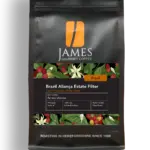
I am lucky enough to have been to Aliança Estate Coffee a few times. Rolling up to the biggest Rubber (plant) Tree that I have ever seen is a Triffid-like house plant that has grown bigger than the 100-year-old estate house.
Aliança is on a different scale from many of the other farms that we buy from in Brazil. The levels of care for coffee plants and people are still great, with much wildlife around. The plantation is enormous but well-tended.
What is special about this lot? It is a yellow bourbon, a coffee harder to produce and more delicate in the cup.
Brazil Aliança Estate Coffee
Farmer: Renato Ishikawa
Varieties: Yellow Bourbon
Altitude: 850-1100 Meters above sea level.
Location:SSão João da Boa Vista, Mogiana region, São Paulo state.
Process: Natural
Farm size: 240 Hectares; 220 of which are grown as coffee.
Harvesting: Manual and mechanical.
Renato bought Aliança in 1977. Fazenda Aliança has its own processing facilities to transform coffee cherries into export-quality beans. The farm-integrated coffee mill includes a wet line and large drying grounds, with sorting and processing equipment. Although very modern, the farm started as a coffee plantation before 1850; the well-preserved main house dates from 1882.
The farm is big enough to have a visiting dentist’s room and child care unit. Basic foodstuff packages are given to temporary workers, and a lot of care goes into welfare.
Over the years, Aliança has been susceptible to frosts that hit the lower-altitude farms. This is nothing new.
In a cupping bowl:
Aromatics: Sweet Chestnut
Body: Super light.
Acidity: Low and sweet.
If you removed the palm oil from a well-known chocolate and hazelnut spread, and most of the sugar too, this is where the first sip took me. Soft dark chocolate, creamy nuts and some brown sugar. This is clean, simple and a really easy brew. After 20 minutes of cooling, some white sugars come to the fore, with chocolatey and nutty elements fading into the background.
In batch brew, this Aliança Yellow bourbon has been working nicely at a straightforward 60g of coffee per litre.